
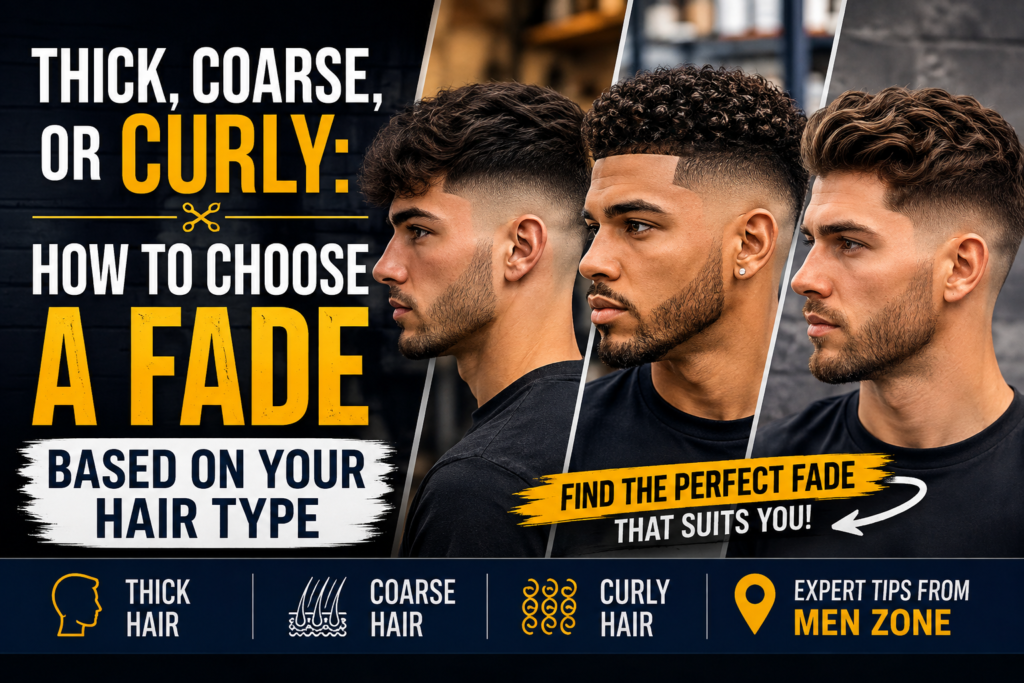
A good fade is more than simply asking for short sides and longer hair on top. The best fade depends on several factors, including your hair type, density, texture, growth pattern, face shape, lifestyle, and the amount of maintenance you are willing to do.
Thick, coarse, and curly hair can all look excellent with a fade, but each texture behaves differently. A fade that works perfectly on straight, fine hair may not create the same result on dense or curly hair. Understanding how your natural texture interacts with different fade styles can help you communicate more clearly with your barber and choose a haircut that looks good as it grows out.
Whether you prefer a subtle taper or a sharp skin fade, the goal is to create a style that works with your hair rather than constantly fighting against it.
If you are searching for a haircut Mississauga clients can maintain easily, understanding your hair type is a useful first step. A professional barber can assess your texture, density, cowlicks, hairline, and growth direction before deciding where the fade should begin and how high it should go.
What Is a Fade Haircut?
A fade is a haircut where the hair gradually transitions from very short around the lower sides and back to longer hair higher up.
Unlike a traditional haircut with a clearly defined length, a fade creates a gradual blend. The transition can be subtle or dramatic depending on the style.
The most common types include:
- Low fade
- Mid fade
- High fade
- Skin fade
- Bald fade
- Taper fade
- Drop fade
- Burst fade
- Temple fade
The important thing to remember is that the fade itself is only part of the haircut. The hair on top also needs to work with your natural texture.
For example, someone with thick straight hair might pair a fade with a textured crop, while someone with curly hair may prefer to keep enough length on top to allow the curls to form naturally.
Why Hair Type Matters When Choosing a Fade
Hair type affects how a fade looks because different textures reflect light, hold shape, and grow differently.
Straight hair generally shows the transition between lengths very clearly. Curly hair can soften the appearance of the blend because curls create additional volume and movement. Thick or coarse hair can create a strong contrast between the faded sides and the top.
Your barber also needs to consider density.
Two people may both have curly hair, but one may have relatively low-density curls while another has extremely dense hair. The same fade height may therefore produce completely different results.
Before choosing a style, consider:
- Your natural texture
- Hair thickness
- Hair density
- Curl or wave pattern
- Hairline
- Cowlicks
- Face shape
- Desired maintenance level
- Length you want on top
- How frequently you plan to visit your barber
Best Fade for Thick Hair
Thick hair gives you plenty of styling possibilities, but it can also create excessive bulk around the sides.
A fade can be particularly useful for thick hair because it removes weight gradually while maintaining length where you want it.
A low fade is a good option if you want to preserve more fullness around the sides.
Low Fade for Thick Hair
The fade begins closer to the ears and neckline, creating a relatively conservative appearance. This can work well if you want your haircut to look professional while still having noticeable volume on top.
A low fade pairs well with:
- Textured crop
- Side part
- Short quiff
- Pompadour
- Messy textured top
- Short curly top
For thick straight hair, ask your barber about removing some bulk from the top without making it excessively thin.
Mid Fade for Thick Hair
A mid fade provides a stronger contrast.
It begins approximately around the middle of the sides and creates a cleaner transition between the top and lower sections.
This can be a good choice if your thick hair tends to become bulky around the temples.
A mid fade works particularly well with textured styles because the reduced volume on the sides makes the top appear more defined.
If you are considering a haircut in Mississauga, bring a photo of your preferred style, but remember that the barber may need to modify the exact fade height according to your hair density.
High Fade for Thick Hair
A high fade removes a significant amount of hair from the sides.
It creates a bold appearance and makes the hair on top the main focus.
High fades can work especially well when you want a strong, modern haircut with a clear contrast.
However, very high fades aren’t automatically the best choice for everyone with thick hair. If you have a naturally narrow or elongated face, removing too much width from the sides may make your face appear longer.
Best Fade for Coarse Hair
Coarse hair is usually thicker in diameter and can feel more rigid or substantial than fine hair.
Because coarse hair often holds its shape strongly, a fade can help create a cleaner overall silhouette.
Low Fade for Coarse Hair
A low fade can keep the haircut looking balanced without exposing too much scalp.
This is useful if you prefer a more traditional appearance.
The barber can gradually reduce the density around the ears and neckline while leaving enough weight higher up.
Mid Fade for Coarse Hair
A mid fade is one of the most versatile options for coarse hair.
It provides enough reduction around the sides to control bulk while maintaining a substantial amount of hair on top.
You can combine it with:
- Crew cut
- French crop
- Textured fringe
- Short quiff
- Side-swept top
- Brush-up style
If your coarse hair naturally stands up, your barber can use texture techniques to make it easier to manage.
Skin Fade for Coarse Hair
A skin fade creates maximum contrast between the scalp and the longer hair.
On coarse hair, this contrast can look particularly sharp because the dense top section stands out against the closely shaved sides.
However, skin fades require more frequent maintenance because the short sides become visibly longer as they grow.
Best Fade for Curly Hair
Curly hair needs a slightly different approach.
The curls themselves provide volume, texture, and shape, so removing too much hair from the sides can dramatically change the overall appearance.
The key is to create a clean outline without destroying the natural curl pattern.
Low Fade With Curls
A low fade is a great starting point if you want to maintain substantial curly volume.
It cleans around the ears and neckline while leaving most of the natural curls intact.
This creates a balanced look that doesn’t make the top appear disconnected from the sides.
Mid Fade With Curly Hair
A mid fade provides more definition.
It can make dense curls on top look more intentional by creating a cleaner transition underneath.
This is especially useful if your curls tend to expand outward.
Instead of trying to completely flatten the curls, the barber can use the fade to control the overall silhouette.
High Fade With Curly Hair
A high fade creates a dramatic contrast.
The curls become the focal point of the haircut, while the sides and back remain very short.
This style can work well for someone who likes a modern, high-contrast appearance.
However, the height of the fade should be chosen carefully. Taking the fade too high can make the haircut look disconnected from the natural curl pattern.
Should You Get a Skin Fade With Curly Hair?
You can, but it depends on your preferred look and maintenance routine.
A skin fade with curls creates a strong contrast between the scalp and curly top. It can look extremely clean immediately after a haircut.
However, curly hair grows in different directions and may make regrowth around the faded area noticeable relatively quickly.
If you want a lower-maintenance option, consider a low or mid fade instead.
A taper can also be a good alternative because it leaves more hair around the sides while still providing a clean finish.
Best Fade for Wavy Hair
Wavy hair sits between straight and curly textures.
Because it naturally creates movement, wavy hair can work with many fade styles.
A low fade can create a relaxed appearance, while a mid or high fade can make the waves on top more prominent.
Try pairing a fade with:
- Textured fringe
- Messy crop
- Side part
- Short quiff
- Medium-length textured top
Avoid over-thinning naturally wavy hair if your goal is to maintain volume. Excessive thinning can sometimes make the hair lose its natural shape.
Best Fade for Straight Hair
Straight hair shows the fade transition very clearly, making blending especially important.
If your hair is straight and thick, a fade can provide a strong, clean contrast.
If your hair is straight and fine, however, an extremely high fade may make the top look less dense.
Low Fade
A low fade is ideal for a classic, understated appearance.
Mid Fade
A mid fade provides a modern balance between subtlety and contrast.
High Fade
A high fade creates a more dramatic look and can make a textured top appear fuller by comparison.
Straight hair also works well with styles such as:
- Slick back
- Side part
- Pompadour
- Quiff
- Crew cut
- French crop
How Face Shape Should Influence Your Fade
Your hair type isn’t the only factor.
Face shape can significantly affect how a fade looks.
Round Face
If your face is relatively round, adding some height on top can create a more elongated appearance.
A mid or high fade combined with controlled volume on top can work well.
Avoid excessive width around the sides if your goal is to create a more structured silhouette.
Oval Face
Oval faces are generally flexible when it comes to haircut choices.
You can experiment with low, mid, or high fades depending on your preferred appearance.
Square Face
A square face often works well with structured fades because the strong jawline complements clean sides.
A mid fade with a textured top can create a balanced look.
Long Face
If your face is already long, be careful with very high fades combined with excessive height on top.
A lower fade with moderate volume can help maintain better proportions.
Diamond Face
A lower or mid fade can work well because it helps maintain some visual width around areas where the face may naturally appear narrower.
Low Fade vs. Mid Fade vs. High Fade
Choosing the fade height is one of the most important decisions.
Low Fade
Best for: Conservative, professional, and natural styles.
It keeps more hair around the sides and creates a subtle transition.
Mid Fade
Best for: Versatility and balanced contrast.
It works with many hair textures and can be adapted to both professional and modern styles.
High Fade
Best for: Bold, high-contrast looks.
It removes more hair from the sides and makes the top the main feature.
Taper Fade
Best for: A cleaner appearance without aggressively reducing the sides.
A taper usually focuses on areas such as the sideburns and neckline and can be a good choice if you don’t want a full fade.
What Is a Drop Fade?
A drop fade follows the natural shape of the head and drops lower toward the back.
This creates a curved appearance rather than a straight fade line.
Drop fades can be especially useful for people with thick or curly hair because they can follow the natural head shape while controlling bulk.
The result can look more customized than a standard straight fade.
What Is a Burst Fade?
A burst fade typically curves around the ear while leaving more length toward the back.
It is commonly paired with textured or curly hairstyles.
For curly hair, the burst fade can create a distinctive silhouette without removing as much hair from the back as a traditional high fade.
It can work particularly well with:
- Curly tops
- Mohawk-inspired styles
- Textured crops
- Longer curly backs
Fade Haircuts for Very Thick and Dense Hair
If you have extremely dense hair, your barber may need to focus on weight management, not simply shortening the hair.
Removing the correct amount of bulk is important.
Too much thinning can make the hair difficult to control, while leaving too much weight can cause the haircut to look heavy.
A good barber considers:
- Where your hair naturally becomes bulky
- How the hair grows
- Your preferred length
- Your styling routine
- Your face shape
- How quickly your hair grows
This is one reason a professional consultation can make a major difference.
The goal isn’t necessarily to remove as much hair as possible. The goal is to create the right shape.
Fade Haircuts for Coarse and Difficult-to-Manage Hair
Coarse hair can sometimes resist styling products and maintain its natural shape strongly.
Rather than trying to force the hair into an entirely different texture, choose a haircut that supports its natural characteristics.
For example, a mid fade combined with a short textured top can reduce side bulk while allowing the natural thickness to become part of the style.
If your hair is particularly dense, ask your barber whether some controlled debulking would help.
How Often Should You Maintain a Fade?
Fade maintenance depends on how short your fade is and how quickly your hair grows.
A skin fade generally needs more frequent visits because even a small amount of regrowth can change the appearance of the blend.
A low taper or longer fade can usually remain presentable for longer.
As a general guideline:
- Skin/bald fade: around 1–2 weeks for a very sharp appearance
- Short fade: around 2–3 weeks
- Low fade/taper: around 3–4 weeks
- Longer textured styles: potentially 4+ weeks depending on the haircut
These aren’t strict rules. Your individual growth rate and desired appearance matter more than the calendar.
How to Explain Your Desired Fade to Your Barber
One of the easiest ways to avoid disappointment is to explain what you actually want rather than simply saying, “Give me a fade.”
Tell your barber:
- How short you want the sides
- Where you want the fade to begin
- How much length you want on top
- Whether you want a natural or sharp finish
- How frequently you maintain your haircut
- Whether you style your hair every morning
- What you dislike about your current haircut
A reference photo can also help.
However, don’t expect an exact copy if your hair texture differs significantly from the person in the photograph.
A professional barber should adapt the style to your natural hair.
Common Fade Mistakes for Thick, Coarse, and Curly Hair
1. Choosing a Fade Only Because It Looks Good in a Photo
The model may have completely different hair density, texture, or face shape.
Use photographs for inspiration, but let your barber adapt the design.
2. Going Too High
A high fade can look excellent, but it isn’t automatically suitable for every face shape or hair type.
3. Removing Too Much From Curly Hair
Curly hair needs enough length to maintain its natural pattern.
4. Ignoring Hair Growth Direction
Cowlicks and unusual growth patterns can affect how a fade sits.
5. Choosing a Skin Fade Without Considering Maintenance
A skin fade looks exceptionally clean when fresh but requires regular upkeep.
6. Over-Thinning Thick Hair
Thinning isn’t always the answer to thick hair. Poorly controlled thinning can affect the shape and texture.
How to Find the Right Haircut Near You
When searching for a haircut near me, don’t choose a barber solely based on proximity.
Look for evidence that the barber understands different hair textures and can adapt fade styles to individual clients.
Consider:
- Recent haircut examples
- Reviews mentioning specific services
- Experience with your hair type
- Cleanliness and professionalism
- Consultation quality
- Consistency of results
- Whether the barber listens to your preferences
For clients in the Mississauga area, looking at local barber services and examples can help narrow down your options before booking.
MEN ZONE, for example, can be considered by clients who want professional men’s grooming and haircut services while choosing a style suited to their individual hair characteristics.
Choosing a Fade Based on Your Lifestyle
Your ideal haircut should fit your daily routine.
If you work in a professional environment, a low fade or taper may provide the right balance between clean and conservative.
If you prefer a modern, noticeable style, a mid or high fade may be more suitable.
If you don’t want frequent barber visits, consider keeping the fade slightly longer.
Your styling routine matters too.
Someone who spends five minutes styling their hair in the morning may want a very different haircut from someone who enjoys spending twenty minutes creating a specific shape.
The best haircut is one you can realistically maintain.
Professional Haircuts and Personalized Fades in Mississauga
Finding the right fade isn’t simply about selecting a number for the sides.
A successful haircut combines your hair texture, density, face shape, desired length, and personal style.
Someone with thick straight hair may benefit from a completely different fade than someone with tightly curled hair. Similarly, coarse hair may require different weight management than fine hair.
If you’re considering a haircut in Mississauga, discuss your hair characteristics with your barber before deciding on the fade height.
A professional consultation can help determine whether a low, mid, high, skin, drop, burst, or taper fade will create the best overall shape.
MEN ZONE focuses on men’s grooming services and can be an option for clients looking for a professional haircut while considering their individual hair type and preferred style.
Frequently Asked Questions
A low or mid fade is often a good starting point for thick hair because it reduces side bulk while maintaining enough length on top. A high fade can also work if you prefer a stronger contrast.
Yes. A skin fade can create a strong contrast with curly hair on top. However, it requires more frequent maintenance and may not be ideal if you prefer a softer, longer-lasting appearance.
A mid fade is a versatile choice for coarse hair because it can reduce bulk while maintaining enough weight on top for styling. The exact fade should be adjusted according to density and growth pattern.
Choose based on your face shape, hair density, desired contrast, and maintenance preferences. A low fade is generally more subtle, while a high fade creates a more dramatic appearance.
Final Thoughts
There isn’t one universally perfect fade.
Thick hair may benefit from a fade that controls excess volume. Coarse hair can work well with structured blends that reduce unwanted bulk. Curly hair often looks best when the fade complements rather than overwhelms the natural curl pattern.
Your face shape, lifestyle, maintenance preferences, and desired appearance should also influence the decision.
Instead of asking only, “Which fade is trending?”, ask:
“Which fade works best with my hair and the way I live?”
That approach will help you choose a haircut that looks good not only when you leave the barbershop, but also as it grows and becomes part of your everyday style.
If you’re researching a haircut Mississauga option, take a few reference photos, understand your hair type, and speak with your barber about the fade height and top length before the clippers start. A personalized approach usually produces a more natural and manageable result than copying a haircut designed for someone with completely different hair.

