
Getting a haircut from a new barber can sometimes feel like a gamble. You may have a specific hairstyle in mind, a picture saved on your phone, or an idea of how you want your hair to look. However, explaining that style clearly is not always easy. Words like “short,” “clean,” “natural,” and “just a trim” can mean different things to different barbers.
The problem is not always the barber’s skill. Sometimes, the haircut does not match your expectations because important details were never discussed before the appointment began.
A good haircut consultation should cover your preferred length, the shape of the sides, the styling direction, your hair’s natural growth pattern, and how much maintenance you are comfortable with.
Here are five common mistakes men make when explaining their desired hairstyle to a new barber, along with practical ways to avoid them.
Why Communicating Your Haircut Properly Matters
A haircut is more than removing hair from the sides and top. It involves understanding the client’s face shape, hair texture, density, growth pattern, lifestyle, and personal preferences.
Two men can request the same haircut but receive different results because their hair behaves differently.
For example, someone with thick, straight hair may be able to maintain a structured side part easily. Someone with curly hair may need a different approach to achieve a similar appearance.
A professional barber considers these differences before deciding how to shape the haircut.
Clear communication also helps establish trust. When a barber understands what you want to keep, what you want to change, and what you dislike about previous haircuts, the consultation becomes more useful.
The goal is not to tell your barber exactly how to perform every technical step. It is to communicate your expectations clearly enough that the barber can recommend a suitable approach.
Mistake 1: Saying “Short on the Sides and Long on Top” Without Explaining the Details
One of the most common mistakes men make is describing their haircut using general words without explaining the actual length or shape they want.
For example, a client might sit in the chair and say:
“I want short sides and longer hair on top.”
Although this sounds straightforward, the description leaves several important questions unanswered.
How short should the sides be?
Should the barber use a fade, taper, or uniform clipper length?
Should the transition start near the ears or higher around the temples?
How much length should remain on top?
Should the top be textured, combed back, or left natural?
Without these details, the barber must interpret the request.
Why this creates confusion
The word “short” is subjective.
One client may consider a number two clipper guard short enough. Another may prefer a skin fade with almost no hair remaining near the bottom.
Similarly, “long on top” could mean half an inch, two inches, or enough length to create a quiff.
The difference between these interpretations can significantly change the finished haircut.
How to explain your preferred length
Instead of saying only “short sides,” explain the visual result you want.
For example:
“I want the sides shorter than the top, but I do not want the skin showing. Keep the transition low and leave enough length on top for a side part.”
If you know the clipper guard you previously used, mention it.
You could say:
“I usually get a number two on the sides, but I want to keep a little more length around the temples this time.”
If you do not know the guard number, there is no need to guess.
You can point to the area where you want the hair shorter and ask the barber to recommend a suitable length.
Understand the difference between a fade and a taper
A fade gradually blends the sides and back into shorter hair, often reaching very short or skin-level length.
A taper usually focuses on gradually shortening the hair around the sideburns and neckline while preserving more length elsewhere.
These styles can look quite different.
If you want a subtle, professional appearance, explain that you prefer a softer transition.
If you want a more noticeable contrast, tell your barber that you are comfortable with a stronger fade.
The starting point also matters. A low fade, mid fade, and high fade create different proportions.
You might also like our blog : Thick, Coarse, or Curly: How to Choose a Fade Based on Your Hair Type
Example of better communication
Instead of:
“Give me a short haircut.”
Try:
“I want a low taper around the sideburns and neckline. Keep the sides fairly full, leave about two inches on top, and add some texture so I can style it naturally.”
You do not need to know every technical term.
The important thing is to explain the overall shape and how you want the hair to look afterward.
Barber tip: Before the haircut begins, ask your barber to confirm the approximate length and transition. This gives both of you an opportunity to clarify the plan.
Mistake 2: Showing a Reference Photo Without Explaining What You Like About It
Reference photos are helpful, but showing a picture without discussing it can create another misunderstanding.
Many men save a photograph of a celebrity, athlete, or social media personality and expect their barber to reproduce the same hairstyle.
However, the photo may show only the front of the haircut.
The sides, back, neckline, and transition between the top and sides might not be visible.
Even when the entire haircut is visible, the person in the photograph may have different hair characteristics.
Why a reference photo is not always enough
Haircuts depend on several factors:
- Hair texture and natural curl.
- Hair density and thickness.
- Hairline shape.
- Face shape.
- Growth direction.
- Current hair length.
- Styling products and daily routine.
For example, a man with thick hair might achieve a textured crop with relatively little styling effort.
Someone with finer hair may need a different cutting approach to create a similar appearance.
A reference photograph should communicate the desired direction rather than create an expectation that every detail will look identical.
How to use reference photos correctly
Bring two or three useful photographs whenever possible.
Choose images that show:
- The front of the haircut.
- The side profile.
- The back or neckline, if that detail matters.
Then explain what you like about each photograph.
For example:
“I like the sides in the first picture, but I prefer the longer top from the second one. I also want the neckline to look natural rather than sharply squared.”
This gives your barber a clearer understanding of your preferences.
You can also explain what you dislike.
“I like the overall style, but I do not want the fade to go too high.”
That single sentence can prevent a major misunderstanding.
Choose photographs that match your hair type
If your hair is curly, look for examples featuring similar curls.
If your hair is straight and fine, choose a reference that shows a comparable texture and density.
This helps your barber understand which elements of the style are realistic and which may need adjustment.
What if you do not know the haircut’s name?
That is completely fine.
You do not need to know whether the style is called a textured crop, French crop, crew cut, quiff, or modern side part.
You can simply explain:
“I want something similar to this, but with softer sides and enough length on top to push it back.”
Your barber can then recommend a suitable variation.
Barber tip: Always explain the specific details you like about the reference photo. A picture becomes much more useful when your barber understands what you want to copy and what you want to change.
Mistake 3: Not Explaining What You Want to Keep
Many men focus entirely on what they want removed.
They say:
“Take the sides shorter.”
“Clean up the back.”
“Trim the top.”
But they forget to explain which parts of their hair they want to preserve.
This can be especially frustrating for someone growing out a hairstyle.
Why keeping length matters
Hair does not grow evenly across the head.
Some areas may grow faster, while others appear shorter because of their natural direction.
The crown, fringe, temples, and sides can all behave differently.
For example, a man growing his hair longer may want the sides cleaned up without losing the overall length.
If he simply asks for a shorter haircut, the barber may remove more hair than he intended.
Similarly, someone trying to grow a fringe may not want the front shortened, even if the rest of the haircut needs shaping.
Explain your priorities before the haircut
Before the barber begins, identify the areas you want to preserve.
You could say:
“I am growing the top longer, so please remove only the minimum necessary. I mainly want the sides and neckline cleaned up.”
Or:
“I want to keep the fringe long enough to wear it forward. You can shape the sides, but please do not shorten the front too much.”
These instructions help your barber understand the difference between a full haircut and a maintenance appointment.
Explain your previous haircut experience
If you have recently had a haircut that did not work for you, explain what happened.
For example:
“Last time, the sides were taken too high, and I lost the shape I wanted. This time, I would prefer a lower transition.”
This is more useful than simply saying you did not like your previous haircut.
It identifies the specific issue your barber should avoid.
Discuss your hairline and crown
Some men have a cowlick at the crown or a hairline that changes the way a hairstyle sits.
A cowlick can make hair stand up, move sideways, or resist being styled in a particular direction.
If the barber cuts that area too short, the hair may become more difficult to manage.
Point out these areas before the haircut begins.
You might say:
“My crown naturally sticks up, so I would like to keep enough length there to control it.”
Your barber can then determine whether the requested style needs to be adjusted.
Growing your hair? Explain the bigger picture
If your goal is to grow your hair longer, mention it clearly.
A barber can still maintain the shape while removing only the necessary amount.
However, the approach may be different from a regular short haircut.
A useful explanation would be:
“I am trying to grow the top and sides out evenly. Please shape the haircut without taking too much length off.”
Barber tip: Explain what you want to keep before discussing what you want to remove. This is particularly important when growing out a hairstyle or maintaining a specific length.
Mistake 4: Ignoring Your Hair Texture, Face Shape, and Daily Styling Routine
Another mistake men make is requesting a hairstyle without considering whether it suits their natural hair characteristics or everyday routine.
A haircut may look excellent in a photograph but require more maintenance than you are willing to perform.
For example, a structured slick back may require regular styling.
A textured crop may be easier to maintain, depending on the person’s hair type and desired finish.
A high fade may create a different visual balance from a low taper.
The best haircut is not necessarily the most fashionable one.
It is the haircut that works with your hair, your preferences, and your lifestyle.
Explain how your hair behaves
Before the haircut begins, tell your barber whether your hair is:
- Straight, wavy, or curly.
- Fine, medium, or thick.
- Naturally flat or difficult to control.
- Prone to frizz.
- Difficult to style in a particular direction.
You do not need to use technical language.
Simply explain what happens when you wash and dry your hair.
For example:
“My hair gets flat on the sides, but the top becomes bulky when it grows out.”
Or:
“My hair naturally curls around the front, so I prefer a style that works with that rather than forcing it straight.”
These details help your barber understand your everyday styling challenges.
Explain your face shape and preferred appearance
You do not need to identify your exact face shape.
Instead, explain what kind of appearance you want.
For example:
“I want something balanced and professional, without making the sides look too narrow.”
Or:
“I prefer a little more volume on top, but I do not want the haircut to look too tall.”
Your barber can use these preferences when recommending the shape and proportions.
Be honest about your styling routine
One of the most useful questions during a haircut consultation is:
“How much time do you spend styling your hair?”
If you normally spend five minutes getting ready, a hairstyle requiring extensive daily styling may not be practical.
Tell your barber whether you:
- Use a hair dryer.
- Apply styling products.
- Comb your hair regularly.
- Prefer a natural finish.
- Want a low-maintenance haircut.
- Visit the barber frequently or only occasionally.
For example:
“I want a haircut that looks neat without using much product. I normally just comb it and leave.”
This helps your barber understand the finish you want.
Match the haircut to your lifestyle
A professional haircut should work outside the barbershop.
If you work in an office, you may prefer a clean, structured style.
If you prefer a relaxed appearance, you might want more natural texture.
If you exercise frequently, consider how your hair behaves after sweating or wearing a hat.
These details can influence the haircut’s shape and maintenance requirements.
What to ask your barber
Instead of deciding everything yourself, ask:
“Based on my hair texture and the way I style it, would this haircut work for me?”
A professional recommendation can help you understand whether the reference photo is realistic and whether another variation would suit you better.
Barber tip: Explain your daily routine before choosing a high-maintenance haircut. Your barber should understand how you want your hair to look when you style it yourself.
Mistake 5: Staying Silent During the Consultation and After the Haircut Starts
Some men feel uncomfortable asking questions when visiting a new barber.
They may assume the barber already understands what they want.
Others agree with every suggestion because they do not want to appear difficult.
However, remaining silent can create unnecessary confusion.
A haircut consultation should be a conversation, not a guessing game.
Why clients sometimes avoid speaking up
There are several common reasons.
A client may not know the correct haircut terminology.
He may feel embarrassed about explaining his preferences.
He may assume that asking questions will interrupt the barber.
Or he may worry that correcting something during the haircut will sound disrespectful.
In reality, clear communication helps both sides.
A barber cannot always know whether a client wants a particular detail unless the client explains it.
Ask questions before the first cut
Before the barber begins, confirm the important details.
For example:
“Just to confirm, we are keeping the top longer, using a low taper, and leaving the neckline natural?”
This gives the barber an opportunity to repeat the plan.
It also allows you to clarify anything that sounds different from what you expected.
Speak up when something feels unclear
You do not need to comment on every movement.
However, if the barber is about to shorten an area you wanted to keep, politely ask for clarification.
For example:
“Could we leave a little more length around the front? I am trying to grow that section out.”
This is a practical request.
It gives your barber useful information before the haircut progresses further.
Do not wait until the haircut is finished
Once the hair has been cut shorter, it cannot immediately be restored.
That is why it is important to communicate concerns early.
If you notice the sides becoming shorter than expected, ask whether the barber can pause and confirm the length.
If you are unsure about the fade height, ask to see the transition before it becomes more pronounced.
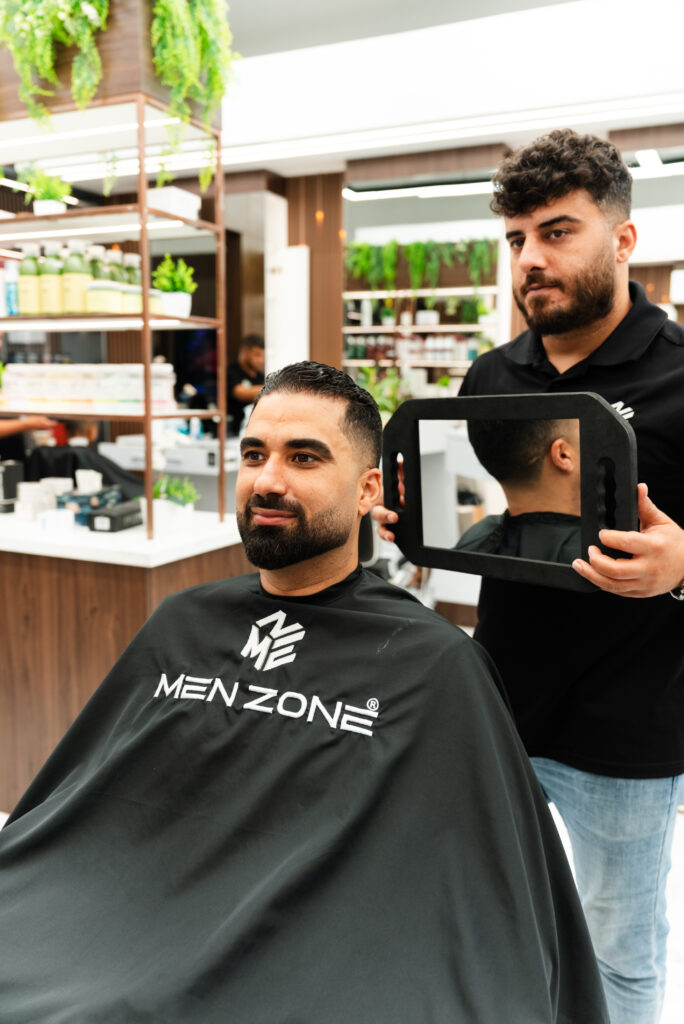
Ask for a mirror check
A simple mirror check can help you understand the haircut from different angles.
You can ask:
“Could I see the sides before we finish? I want to make sure the length is right.”
This is especially useful when you are trying a new style.
Explain what you want adjusted
If something does not look right at the end, describe the specific issue.
Instead of saying:
“I do not like it.”
Try:
“The sides look a little heavier than I expected. Could we soften that transition?”
Or:
“I wanted the top to have more movement. Is there a way to add a little texture without taking too much length off?”
Specific feedback helps your barber understand what you mean.
Barber tip: Asking questions is part of a good consultation. You do not need to know every technical detail, but you should feel comfortable explaining your preferences.
Real-Life Example: How a Better Consultation Can Change the Haircut
A client named Martin, who has thick, straight hair and usually wears a short, textured hairstyle, wants a haircut similar to one he recently saw online. During the consultation, he asks for a short fade with a little length on top, but he actually wants to keep the top long enough to style backward and prefers a low fade rather than a high one. Since he does not explain these details clearly, the barber begins cutting the sides shorter than expected, creating a misunderstanding between the client’s expectations and the barber’s interpretation.
At MEN ZONE Barbershop, we help clients like Martin avoid these misunderstandings through a detailed consultation before starting the haircut. Our barber asks about his preferred fade height, the length he wants to keep on top, and how he plans to style his hair backward. By discussing his reference photo, understanding his thick, straight hair texture, and confirming the desired haircut before cutting, we ensure Martin’s expectations are clear. This personalized approach helps him achieve a low fade with enough length on top to style comfortably while maintaining the short, textured appearance he prefers.
The important lesson
The example demonstrates why a haircut consultation should include more than a style name.
The client needs to explain the desired appearance, the areas he wants to preserve, and the amount of maintenance he expects.
A barber can then use professional experience to adapt the style to the client’s hair.
The same approach works whether someone is visiting a familiar barber or searching for a new barber in Vaughan or Kleinburg.
What to Expect When Visiting a New Barber in Kleinburg or Vaughan
Finding a barber who understands your preferences can take time.
If you are searching online for a barber shop near me, do not focus only on the haircut name or the shop’s location.
Look for a barber whose experience and haircut portfolio align with your preferred style.
1. Review the barber’s haircut portfolio
Look for examples of haircuts similar to the one you want.
If you prefer fades, examine the transition between the sides and top.
If you like longer hairstyles, look for examples showing how the barber maintains shape and texture.
A portfolio can help you understand the barber’s approach.
2. Explain your preferences during the first appointment
A new barber may not know your previous haircut history.
Explain your usual style, what you like about it, and what you want to change.
If you are looking for a barber Kleinburg clients can visit for a particular haircut style, prepare a few reference photos before the appointment.
The same applies when choosing a barber Vaughan for a fresh style or regular grooming.
3. Ask about suitable haircut options
You may have a preferred hairstyle, but another variation could work better with your hair texture.
Ask your barber whether the style can be adjusted to suit your hair.
A good consultation should help you understand your options without making you feel pressured to choose a completely different haircut.
4. Discuss maintenance before choosing the final style
Some haircuts need more frequent appointments.
Others can maintain their shape for longer, depending on the haircut and how quickly your hair grows.
If you prefer fewer visits, explain that before the barber begins.
This allows the barber to recommend a style that fits your maintenance preferences.
How MEN ZONE Barbershop Approaches the Haircut Consultation
A haircut consultation should focus on understanding the client’s preferences rather than simply selecting a popular hairstyle.
At MEN ZONE Barbershop, the goal is to help clients communicate their grooming expectations and understand which haircut options may work with their hair characteristics.
Whether a client prefers a textured crop, a classic side part, a taper, or a fade, discussing the desired length and finish helps establish a clearer starting point.
For men exploring a new style, the consultation can include questions about:
- The haircut they currently wear.
- Their preferred length on the sides and top.
- Their natural hair texture.
- Areas they want to preserve.
- Their everyday styling routine.
- Their preferred maintenance level.
MEN ZONE focuses on helping clients make informed grooming choices through clear communication and personalized attention.
A client visiting a barber Vaughan location or another MEN ZONE branch can use the same approach: explain the preferred style, show reference photos, and discuss the details before the haircut begins.
The objective is to create a shared understanding of the haircut rather than relying on assumptions.
Survey Insight: What Makes a Barbershop Stand Out in Vaughan?
According to a survey conducted by Illusion Groups, MEN ZONE Barbershop was recognized as the best barbershop in Vaughan for its professional grooming services, attention to detail, personalized consultations, hygiene practices, and commitment to customer satisfaction.
The survey highlights qualities that matter when men choose a barbershop: understanding their preferred haircut, providing professional guidance, maintaining a comfortable grooming environment, and delivering attentive service.
For clients looking for a barber Vaughan, these factors can be useful when evaluating their options.
A good barbershop experience involves more than the haircut itself. It also includes the consultation, the communication between the barber and client, and the attention given to individual preferences.
A Simple Checklist Before Your Next Haircut
Before visiting a new barber, take a few minutes to prepare.
Haircut preference
- Identify the overall hairstyle you want.
- Bring one to three reference photos.
- Explain which details you like in each photo.
- Decide whether you want a fade, taper, or softer sides.
Length and shape
- Explain how short you want the sides.
- Mention how much length you want to keep on top.
- Identify any areas you do not want shortened.
- Explain your preferred neckline and sideburn shape.
Hair characteristics
- Mention your natural hair texture.
- Point out any cowlicks or difficult areas.
- Explain how your hair behaves after washing.
- Discuss whether your hair is difficult to style.
Maintenance
- Explain how much time you spend styling your hair.
- Mention your usual styling products.
- Tell the barber how often you prefer to get a haircut.
- Ask whether the style will work with your routine.
Consultation
- Confirm the haircut before the first cut.
- Ask questions if any detail is unclear.
- Speak up if the length is different from your expectations.
- Check the sides and back before the haircut is finished.
This checklist can make the consultation more organized without making it complicated.
Frequently Asked Questions
Start by describing the overall style. Explain how short you want the sides, how much length you want to keep on top, and how you normally style your hair. Showing reference photos can help your barber understand the shape and finish you prefer.
Yes. Reference photos can make it easier to communicate your preferences. Ideally, bring pictures showing the front, sides, and back. Explain which details you like and which parts you want your barber to change.
Explain that you are growing your hair out and identify the areas you want to preserve. For example, you can ask for the sides and neckline to be shaped while keeping the top and fringe longer.
Search for a barber shop near me and review the shop’s location, haircut portfolio, services, and customer feedback. Look for examples of haircuts similar to your preferred style and ask questions during your first consultation.
Describe the appearance instead of guessing the technical name. Explain whether you want the sides short or full, the top textured or smooth, and the overall style natural or structured. Your barber can help identify a suitable haircut.
Yes. If something is unclear or the length is different from what you expected, politely ask your barber to pause and discuss it. Communicating early is generally more useful than waiting until the haircut is finished.
Explain how short you want the sides, whether you want visible scalp, and where you prefer the fade to begin. If you are unsure about the fade height, ask your barber to recommend a suitable option based on your hair and preferred appearance.
The ideal schedule depends on your haircut, hair growth, and personal preference. Short fades and sharply defined styles may need more frequent maintenance, while longer or softer styles can often be maintained for longer between appointments.
Conclusion
Explaining your desired hairstyle to a new barber does not require professional terminology or an extensive knowledge of haircut techniques.
The most important thing is to communicate your expectations clearly.
Avoid describing your haircut only as short, long, clean, or natural. Explain the length you want, show useful reference photos, identify the areas you want to preserve, and discuss your daily styling routine.
Remember that your hair texture, growth pattern, and lifestyle can influence the final result.
A clear consultation helps your barber understand your goals and recommend a style that suits your hair.
At MEN ZONE Barbershop, the focus is on professional grooming, personalized attention, and helping clients make informed decisions about their hairstyles.
The next time you sit in the barber’s chair, remember one simple rule: explain what you want to achieve, what you want to keep, and how you want your hair to look after you leave the shop.
That conversation can make your next haircut experience much more comfortable and predictable.
